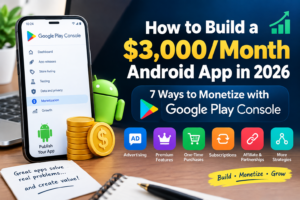
Learning how to make money with an Android app can be a practical way to explore online income in 2026. You do not need to start with a large company or a complex application. A simple app that solves a specific problem can be tested with a small audience and improved over time.
In this guide, we’ll look at 7 practical ways to monetize an Android app, including advertising, subscriptions, in-app purchases, paid apps, affiliate offers, and digital products.
The amount an app can earn varies widely. Results depend on the app’s usefulness, audience, traffic, monetization model, user engagement, and operating costs. The goal is to understand the available options and choose a model that fits the type of app you want to build.
If you want to make money with an Android app, start by solving a specific problem for a clearly defined audience.
1. Start With a Problem People Actually Have
How to Make Money With an Android App
Before thinking about money, think about the problem your app solves.
Successful app ideas often focus on a specific need rather than trying to do everything.
For example:
- Productivity tools
- Education apps
- Language-learning tools
- Fitness utilities
- Finance-related tools
- Daily planners
- AI-powered utilities
- Religious or lifestyle apps
- Photo and video tools
- Simple business utilities
A simple app that solves one problem well can be easier to explain and market than an app with dozens of unrelated features.
Your first question should be:
“Why would someone install this app instead of using an existing alternative?”
That question can help you improve the product before spending money on advertising.
2. Monetize With Advertising
Advertising is one possible monetization model for free Android applications.
The basic idea is simple:
Users download and use the free app while advertisements generate revenue.
Common formats can include:
- Banner ads
- Interstitial ads
- Rewarded ads
- Native ads
However, advertising revenue depends heavily on factors such as:
- Number of active users
- User engagement
- Geographic location
- Ad format
- Ad demand
- Session frequency
This means an app with 10,000 downloads does not automatically make a specific amount of money.
For a $3,000/month business goal, you would need to understand your actual revenue per user and then calculate how many active users would be required.
3. Offer a Premium Version
Another approach is to offer a free version and charge for additional features.
For example:
Free version
- Basic tools
- Limited usage
- Standard interface
Premium version
- Extra features
- No advertising
- Advanced settings
- More usage
- Additional content
Google Play supports one-time digital products, which can be used for premium upgrades and other digital features.
This model can work particularly well when the premium feature provides clear value.
4. Create a Subscription
Subscriptions can provide recurring revenue when an application offers continuing value.
Possible subscription features include:
- Premium content updated regularly
- Advanced AI tools
- Cloud features
- Professional tools
- Regular educational content
- Additional productivity features
Google Play subscriptions use subscription products, base plans, and offers. Developers must clearly explain the price, billing period, renewal terms, and benefits to users.
A subscription should not simply lock a one-time feature behind a recurring payment. Google requires subscriptions to provide sustained or recurring value throughout the subscription period.
5. Sell One-Time Digital Products
Not every app needs a subscription.
You can also offer a one-time purchase.
Examples include:
- Premium themes
- Extra content
- Permanent feature unlocks
- Additional tools
- Digital packs
- Premium levels
- Ad-free upgrades
Google Play refers to these as one-time products. They can provide a permanent benefit when configured as non-consumable products.
This can be attractive to users who don’t want another monthly subscription.
6. Build an App Around a Larger Business
Your Android application doesn’t necessarily have to be the entire business.
It can also become an entry point into a larger ecosystem.
For example, an app could connect users with:
- A website
- Digital products
- Educational resources
- Affiliate offers
- Online services
- A newsletter
- Premium web features
The key is to make the relationship between the app and the business useful rather than simply sending users away from the app.
If your app sells digital features or content inside the Play-distributed application, Google Play’s payment rules can apply. Developers should check the current Payments policy before implementing a monetization flow.
7. Combine Multiple Revenue Streams
One of the more flexible strategies is combining several monetization methods.
For example, an app could have:
Free users → Advertising
Power users → Premium upgrade
Regular users → Subscription
Website visitors → Additional products or services
This creates multiple potential revenue sources instead of depending entirely on advertising.
However, adding more monetization does not automatically make an app more profitable. Too many ads, aggressive purchase prompts, or confusing subscriptions can damage the user experience.
Google specifically requires subscription offers and purchase experiences to be transparent and not deceptive.
What Would $3,000 a Month Actually Mean?
A $3,000/month target can be broken down mathematically.
For example, if a product generated an average of:
$5 per paying customer per month
you would need approximately:
600 paying customers
before considering refunds, platform fees, taxes, and other costs.
If the average monthly revenue per paying customer were:
$10
you would need approximately:
300 paying customers
Again, these are simple illustrations, not predictions.
The actual numbers depend on your pricing, conversion rate, retention, fees, and other business costs.
Don’t Focus Only on Downloads
Downloads are useful, but they are not the same as revenue.
A better set of metrics includes:
- Active users
- Retention
- Sessions
- Conversion rate
- Paying customers
- Average revenue per user
- Subscription cancellations
- Advertising revenue
- Customer acquisition cost
For example, an app with 5,000 highly engaged users could potentially be more valuable than an app with 50,000 users who rarely open it.
A Simple Example
Imagine you create a productivity application.
Your model could look like this:
10,000 monthly active users
↓
5% become paying customers
↓
500 paying customers
↓
$7 average monthly revenue per paying customer
↓
$3,500 gross monthly revenue
This is only an example to show how the numbers can work. It is not a guarantee that an app will reach these results.
You would still need to account for Google Play fees, taxes, refunds, marketing, development, and other expenses.
Google’s service-fee structure varies depending on the transaction, program, market, and developer circumstances, so you should check the current fee information when calculating your actual net revenue.
How to Build Your First App
If you are a beginner, don’t start by trying to build a huge application.
Start with a small version.
Step 1: Choose one problem
Find a specific problem your target user has.
Step 2: Build the minimum useful version
Create only the features necessary to solve that problem.
Step 3: Test with real users
Ask users what works and what doesn’t.
Step 4: Improve the application
Fix bugs and improve the most important features.
Step 5: Prepare Google Play
Create your store listing, screenshots, icon, privacy information, and other required information.
Step 6: Add monetization
Choose the model that makes sense for the application:
- Ads
- One-time purchase
- Subscription
- Premium upgrade
- Combination
Step 7: Measure everything
Watch your users and revenue data.
Then improve the app based on actual results rather than assumptions.
Can a Beginner Really Build a $3,000/Month App?
It is possible for an app business to reach different revenue levels, but there is no guaranteed path to $3,000 per month.
The biggest mistake beginners make is starting with the income target instead of the user problem.
Instead of asking:
“How can I make $3,000?”
start with:
“What useful problem can I solve for a specific group of users?”
Then build, test, improve, and monetize the solution.
Final Thoughts
A $3,000/month Android app is better viewed as a business goal rather than a promise of income.
Google Play gives developers several monetization options, including one-time products and subscriptions, while advertising and broader online-business models can provide additional possibilities.
The most important factors are the quality of the app, the problem it solves, user demand, retention, pricing, marketing, and responsible monetization.
Start small, solve a real problem, collect feedback, and use your data to decide what to improve next.
That is a much more sustainable approach than simply chasing a $3,000 revenue number.
If your goal is to make money with an Android app, focus first on building something useful for a specific type of user.
Before trying to make money with an Android app, choose a monetization method that fits how people will use your app.
If you are interested in building online income with digital tools, you can also read our guide to 10 Free AI Tools You Can Use to Make Money Online in 2026.