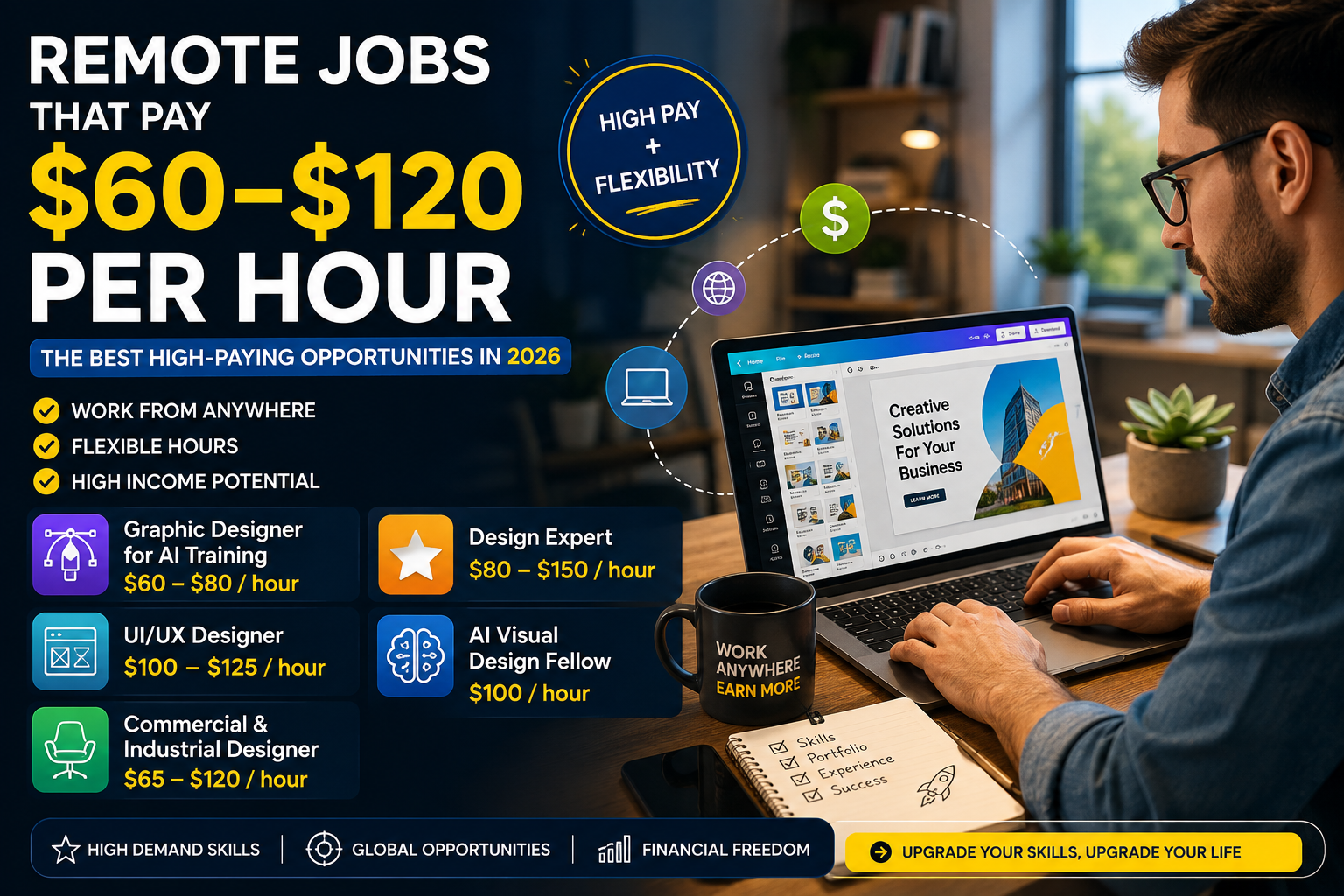
Remote Jobs That Pay $60–$120 Per Hour: 10 High-Paying Opportunities in 2026
Remote work has become an important part of the modern job market. Many professionals now work from home or from another location while providing services to companies, agencies, startups, and individual clients.
If you are searching for remote jobs that pay $60-$120 per hour, it is important to understand that these income levels are not typical for every remote worker. Higher hourly rates usually come with specialized skills, professional experience, strong portfolios, certifications, or expertise in a valuable area.
The good news is that there are several remote career paths where experienced professionals can potentially charge higher hourly rates.
This guide explores 10 remote opportunities, what each role involves, what skills may be required, how beginners can start developing those skills, and what factors can affect your earning potential.
Important: The hourly rates discussed in this article are examples of potential market rates, not guaranteed earnings. Actual pay can vary significantly depending on experience, location, industry, client demand, contract type, and the specific work being performed.
What Are Remote Jobs That Pay $60-$120 Per Hour?
Remote jobs that pay $60-$120 per hour generally involve skills that businesses consider valuable or difficult to replace.
These roles may include technology, consulting, marketing, design, finance, writing, project management, and other specialized services.
Some professionals earn an hourly rate directly from an employer, while freelancers and consultants may set their own rates for specific projects.
For example, an experienced developer may charge an hourly consulting rate, while a freelance designer may price a project based on the expected amount of work.
The important point is that a high hourly rate usually reflects the value and experience of the professional rather than simply the fact that the job is remote.
10 Remote Jobs That Can Reach $60-$120 Per Hour
1. Software Developer
Software development is one of the most established remote career paths in the technology industry.
Developers can work on websites, mobile applications, business software, APIs, databases, and other digital products.
Experienced developers may work remotely for companies or operate as independent contractors.
Common areas include:
-
Web development
-
Mobile development
-
Backend development
-
Frontend development
-
Full-stack development
-
Software testing
-
API development
-
Cloud applications
Skills You May Need
Depending on the specialization, developers may learn programming languages such as JavaScript, Python, Java, C#, PHP, or other technologies.
You may also need to understand databases, version control, APIs, testing, and software development workflows.
How to Start
Beginners can start by learning one programming language and building small projects.
Instead of trying to learn every programming language, choose one direction and create a portfolio.
A portfolio might include:
-
A website
-
A small web application
-
A useful automation tool
-
A mobile application
-
An open-source contribution
Experience and the ability to solve real problems are important when trying to reach higher rates.
2. Cybersecurity Specialist
Cybersecurity professionals help organizations protect systems, networks, applications, and information.
Because security problems can create significant risks for businesses, experienced cybersecurity professionals can be highly valuable.
Remote cybersecurity work can include:
-
Security monitoring
-
Vulnerability assessments
-
Security testing
-
Risk analysis
-
Incident response
-
Security consulting
-
Compliance support
Skills and Certifications
People entering cybersecurity may study networking, operating systems, security principles, cloud technologies, and security tools.
Professional certifications can also be useful depending on the role.
However, certification alone does not guarantee a high salary or hourly rate. Practical experience and specialized knowledge remain important.
Beginner Path
A beginner could start with networking fundamentals, Linux, basic security concepts, and hands-on practice environments.
Over time, they can specialize in areas such as cloud security, penetration testing, or security operations.
3. Data Analyst or Data Consultant
Businesses collect large amounts of information and need professionals who can turn data into useful insights.
Data analysts may work with:
-
Spreadsheets
-
SQL
-
Databases
-
Business intelligence tools
-
Statistics
-
Data visualization
More experienced professionals may move into consulting or specialized analytics roles.
What the Work Involves
A data professional might help a company understand:
-
Sales performance
-
Customer behavior
-
Marketing results
-
Website traffic
-
Operational costs
-
Product performance
The ability to explain data clearly can be just as important as technical knowledge.
How to Build Experience
Start with spreadsheet analysis and basic SQL.
Then create portfolio projects using public datasets.
For example, you could analyze an ecommerce dataset and create a report explaining sales trends, customer segments, and possible business questions.
4. AI Consultant or AI Automation Specialist
Artificial intelligence has created new opportunities for professionals who understand both AI tools and business workflows.
An AI automation specialist may help companies reduce repetitive work using software, APIs, AI tools, and automation platforms.
Possible projects include:
-
Automated customer support workflows
-
Content workflows
-
Lead management
-
Document processing
-
Internal knowledge systems
-
Data organization
-
Business process automation
What Makes This Skill Valuable?
The valuable part is not simply knowing how to use an AI chatbot.
Businesses usually need someone who can understand a workflow and identify where automation can save time or reduce repetitive tasks.
For example, a company might receive hundreds of customer inquiries each week. An automation specialist could help organize incoming messages, classify requests, and route them to the correct team.
How to Start
Learn basic automation concepts first.
Then practice with simple workflows and build demonstrations showing how a process can be improved.
5. Digital Marketing Consultant
Digital marketing includes many different skills, including SEO, paid advertising, email marketing, content strategy, analytics, and social media.
Experienced consultants may work remotely with multiple businesses.
A marketing consultant might help a company:
-
Improve its website traffic
-
Develop content strategies
-
Optimize conversion funnels
-
Manage email campaigns
-
Analyze marketing data
-
Plan social media campaigns
Important Skills
You may need to understand:
-
Search engine optimization
-
Analytics
-
Content marketing
-
Conversion optimization
-
Audience research
-
Email marketing
Marketing results can be difficult to predict, so professionals should avoid promising guaranteed traffic, sales, or revenue.
Building a Portfolio
One way to demonstrate your skills is to create your own website and document what you learn.
You can also create sample marketing audits for imaginary businesses or volunteer to help a small organization build practical experience.
6. UX/UI Designer
UX and UI designers work on the experience and visual interface of websites, mobile applications, and digital products.
UX focuses heavily on how users interact with a product, while UI is more focused on the visual interface.
Typical work can include:
-
User research
-
Wireframes
-
Prototypes
-
Interface design
-
Design systems
-
Usability testing
Tools
Designers commonly use digital design and prototyping tools to create and test interfaces.
However, tools are only part of the skill.
A strong designer needs to understand:
-
User needs
-
Layout
-
Navigation
-
Typography
-
Accessibility
-
Visual hierarchy
How to Start
Create several fictional projects and document your decisions.
A good portfolio should explain not only what the final interface looks like, but also why you designed it that way.
7. Financial Consultant or Specialized Accountant
Finance includes many remote opportunities, especially for professionals with formal education, certifications, and industry experience.
Potential remote roles include:
-
Financial analysis
-
Accounting
-
Tax support
-
Bookkeeping
-
Financial planning
-
Business consulting
Some positions require specific professional qualifications or licenses depending on the country and service.
Why Experience Matters
Financial work can involve sensitive information and significant consequences.
Businesses often look for professionals who understand regulations, financial reporting, risk, and industry-specific requirements.
If you are interested in this field, research the qualifications required in your jurisdiction before offering professional services.
8. Technical Writer
Technical writers explain complicated subjects in a way that is easier for readers to understand.
They may create:
-
Software documentation
-
User guides
-
Help articles
-
Knowledge bases
-
Technical tutorials
-
Product documentation
Technology companies often need clear documentation for their customers and employees.
Useful Skills
Technical writing requires strong communication and the ability to understand technical subjects.
You do not necessarily need to be a software engineer, but you should be comfortable researching technical information and asking precise questions.
How to Build a Portfolio
Create sample documentation for a fictional software product.
You could also improve an existing public tutorial as a writing exercise.
Your portfolio should demonstrate clarity, organization, accuracy, and attention to detail.
9. Project Manager
Remote project managers coordinate people, deadlines, budgets, communication, and deliverables.
They can work in technology, marketing, construction, consulting, education, and many other industries.
Common responsibilities include:
-
Creating project plans
-
Managing deadlines
-
Organizing meetings
-
Tracking tasks
-
Communicating with stakeholders
-
Identifying risks
-
Coordinating team members
Skills You May Need
Important skills include:
-
Communication
-
Organization
-
Leadership
-
Problem solving
-
Time management
-
Documentation
Project management experience is often developed through actual projects rather than simply studying theory.
If you are a beginner, start by managing smaller projects and learning how professional teams organize their work.
10. Specialized Freelance Consultant
Another category includes specialized consultants who provide expertise to businesses on a project or hourly basis.
Examples can include:
-
SEO consulting
-
Business process consulting
-
Content strategy
-
Ecommerce consulting
-
Sales consulting
-
Recruitment consulting
-
Operations consulting
The more specialized your knowledge, the easier it can be to explain the specific value you provide.
Why Consultants Can Charge More
Consultants are often hired to solve specific problems.
A company may prefer to pay an experienced specialist for a short project instead of hiring a full-time employee for every task.
However, reaching higher consulting rates usually takes time.
You need:
-
Demonstrated expertise
-
Case studies
-
A strong portfolio
-
Client results
-
Professional communication
-
A clear service offer
What Skills Can Help You Reach Higher Remote Rates?
If your goal is to eventually qualify for higher-paying remote work, focus on skills that solve valuable problems.
Some examples include:
Technical Skills
-
Programming
-
Cloud computing
-
Cybersecurity
-
Data analysis
-
Automation
-
Software development
Creative Skills
-
UX/UI design
-
Technical writing
-
Video production
-
Content strategy
-
Brand design
Business Skills
-
Digital marketing
-
Sales
-
Project management
-
Consulting
-
Business analysis
You do not need to learn all of these.
Choose one area and develop deeper expertise.
How to Start if You Have No Experience
One of the biggest challenges for beginners is the experience requirement.
You can begin by creating your own projects.
For example, if you want to become a web developer, build websites.
If you want to become a designer, create interfaces.
If you want to become a data analyst, analyze public datasets.
If you want to become a writer, create detailed sample articles.
Your first projects do not need to be paid.
Their purpose is to demonstrate what you can do.
Build a Portfolio Before Chasing High Hourly Rates
A portfolio is often more useful than simply saying that you have a skill.
A good portfolio should show:
-
Your specialty
-
Your best projects
-
The problem you solved
-
Your process
-
The final result
-
Your contact information
For consultants and freelancers, case studies can be especially useful.
A case study can explain:
Problem → Process → Solution → Result
If you do not have client results yet, clearly label your projects as personal or sample projects.
Where Can You Find Remote Work?
There are several places where professionals can explore remote opportunities.
These can include:
-
Company career pages
-
Freelance marketplaces
-
Professional networking platforms
-
Remote job boards
-
Industry communities
-
Direct outreach
You should also research companies directly.
If a company regularly hires contractors or remote specialists, it may be worth monitoring its career page.
Freelance vs Remote Employment
There is an important difference between freelancing and employment.
A remote employee may receive a salary or hourly wage and potentially benefits.
A freelancer or consultant usually handles their own taxes, contracts, insurance, equipment, and business expenses depending on their location.
The advertised hourly rate is therefore not always equivalent to personal take-home income.
How to Improve Your Chances of Getting Higher-Paying Work
Higher-paying opportunities usually require more than technical ability.
1. Specialize
Instead of saying:
“I do digital marketing.”
You could say:
“I help small ecommerce businesses improve their organic search content.”
Specific positioning can make your offer easier to understand.
2. Show Your Work
Do not rely only on a resume.
Show potential clients what you can actually do.
3. Communicate Clearly
Clients want professionals who respond clearly, meet deadlines, and understand instructions.
4. Continue Learning
Technology changes quickly.
Professionals who keep learning can adapt as tools and business needs change.
5. Focus on Results Without Making Guarantees
Explain what you can realistically deliver.
Avoid promising a specific revenue increase unless you have reliable evidence and appropriate conditions.
Are $60-$120 Per Hour Remote Jobs Realistic for Beginners?
For most beginners, reaching this level immediately is unlikely.
Higher hourly rates are generally associated with specialized skills, experience, professional credentials, strong portfolios, or a combination of these factors.
A beginner should focus first on becoming useful.
A realistic progression might look like:
Learn → Practice → Build Portfolio → Get Small Projects → Gain Experience → Specialize → Increase Value
Your first remote opportunity does not need to pay $120 per hour.
The goal can be to develop skills that create access to better opportunities over time.
Remote Work Skills You Can Start Learning in 2026
If you are starting today, consider choosing one of these areas:
-
AI-assisted workflows
-
Web development
-
Data analysis
-
Cybersecurity
-
Digital marketing
-
UX/UI design
-
Technical writing
-
Project management
If AI interests you specifically, you can also explore our guide on 7 AI Skills for Remote Work You Can Learn in 2026.
Developing complementary skills can make you more useful than relying on one tool.
A Simple 90-Day Plan
Days 1–30: Learn
Choose one skill and study the fundamentals.
Use free learning resources where possible.
Practice every day or several times each week.
Days 31–60: Build
Create three to five portfolio projects.
Improve your work based on feedback.
Create a simple professional profile.
Days 61–90: Apply
Start applying for relevant opportunities.
Contact potential clients.
Improve your proposals.
Track which applications receive responses.
Continue building your portfolio.
Common Mistakes to Avoid
Applying for Everything
Sending applications for jobs you are not qualified for can waste time.
Focus on opportunities that match your current skills.
Chasing Hourly Rates Instead of Skills
The hourly rate should not be your only goal.
Building valuable expertise can create better opportunities over time.
Paying for Expensive Courses Too Early
You can learn many fundamentals using free educational resources.
Before paying for an expensive course, research the instructor, curriculum, reviews, and whether the skill is actually relevant to your career goal.
Using AI Without Understanding the Work
AI can help with many tasks, but you still need to understand what you are delivering.
Always review important AI-assisted work.
Frequently Asked Questions
What remote jobs can pay $60-$120 per hour?
Potential examples include experienced software developers, cybersecurity specialists, consultants, specialized marketers, UX/UI designers, technical writers, financial professionals, project managers, and other specialists. Actual compensation varies widely.
Can I get a $100-per-hour remote job with no experience?
It is possible to find high-value freelance work eventually, but beginners generally need to develop skills and experience first. There is no guaranteed path to a specific hourly rate.
Do remote jobs always pay hourly?
No. Remote workers can be paid through salaries, hourly rates, project fees, retainers, commissions, or other compensation structures.
Is freelancing better than a remote job?
They are different work models. Employment can provide more predictable compensation and potentially benefits, while freelancing can offer flexibility and the ability to work with multiple clients. The right choice depends on your situation and preferences.
Can AI help me get a high-paying remote job?
AI can help you learn, research, automate repetitive tasks, and improve productivity. However, having access to AI does not automatically qualify someone for a high-paying job. Employers and clients still value skills, experience, reliability, and results.
What should I learn first?
Choose one area that matches your interests and abilities. Technology, data, cybersecurity, marketing, design, writing, and project management can all provide paths into remote work.
Final Thoughts
There are real opportunities to work remotely in technology, marketing, design, finance, consulting, writing, and other specialized fields.
However, remote jobs that pay $60-$120 per hour generally require more than simply finding a job listing.
They often require valuable skills, experience, a strong portfolio, professional communication, and the ability to solve problems for employers or clients.
If you are a beginner, do not feel that you need to reach a high hourly rate immediately.
Start with one skill.
Learn the fundamentals.
Build real projects.
Create a portfolio.
Apply for opportunities.
Learn from feedback.
Then gradually increase the value of the work you can provide.
Remote work can be a long-term career path, but sustainable results usually come from developing useful skills rather than chasing quick-money promises.
If you want to explore WordPress as a way to build an online income stream, you can also read our detailed guide on How to Make $3,000 a Month With WordPress in 2026. It explains different WordPress-based business models, including content websites, affiliate marketing, digital products, and other ways a website can potentially generate revenue.